The First Duty and the Right of Hte Art of War Is to Keep Policy From Demanding Things That Go
Caesar Augustus
Caesar Augustus
Caesar Augustus was one of ancient Rome's most successful leaders who led the transformation of Rome from a democracy to an empire. During his reign, Augustus restored peace and prosperity to the Roman land and inverse nearly every aspect of Roman life.
Subjects
Social Studies, Earth History
Image
Caesar Augustus
This statue is thought to depict Caesar Augustus, the first emperor of the Roman Empire.
National Geographic Creative

Caesar Augustus was born Gaius Octavius in 63 B.C. His groovy-uncle was Julius Caesar, who he fought abreast in 47 B.C. Augustus impressed his swell uncle so much during battle that when Julius Caesar was assassinated in 43 B.C., he had appointed Augustus as heir to his political and personal fortune in his volition. Augustus, at the age of nineteen, accepted the inheritance from Caesar's will and was quickly plunged into the complicated globe of Roman politics. He apace formed strategic alliances, defeated his political rivals, and won a bitterly fought ceremonious war. In 31 B.C. at the Battle of Actium, Augustus won a decisive victory over his rival Marker Antony and his Egyptian fleet. Returning to Rome, Augustus was acclaimed a hero. With skill, efficiency, and cleverness, he secured his position as the first Emperor of Rome. Augustus claimed he acted for the glory of the Roman Republic, not for personal power. He appealed to Roman citizens by challenge that he led a frugal and pocket-sized life. Augustus reorganized Roman life throughout the empire. He passed laws to encourage marital stability and renew religious practices. He instituted a arrangement of taxation and a census while also expanding the network of Roman roads. He founded a mail service and established a regular police force and fire brigade in Rome. Augustus expanded the empire, annexing Egypt, part of Espana, areas of central Europe, and fifty-fifty lands in the Middle Eastward, such as Judea in A.D. 6. These additions, along with the finish of civil wars, fostered the growth of an enormous trading network. Augustus died outside of Naples, Italy in A.D. 14. His torso was returned to the capital letter. Businesses airtight the 24-hour interval of his funeral out of deep respect for the emperor. He was a ruler of power and vision and at his death, Augustus was proclaimed by the Senate to be a Roman god.
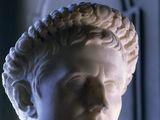
This statue is thought to describe Caesar Augustus, the start emperor of the Roman Empire.
National Geographic Creative
emperor
Substantive
ruler of an empire.
empire
Noun
group of nations, territories or other groups of people controlled by a unmarried, more than powerful authority.
inherit
Verb
to receive from ancestors.
Julius Caesar
Noun
(100 BCE-44 BCE) leader of ancient Rome.
network
Noun
series of links along which movement or communication can have place.
plunge
Verb
to enter suddenly, especially into water.
politics
Substantive
fine art and science of public policy.
democracy
Noun
organization of government where power rests in citizens who vote and representatives who stand for those citizens. The Us is a republic.
Roman
Describing word
having to do with the civilization of ancient Rome, including the kingdom, republic, and empire.
victory
Substantive
success or triumph.
hillbossubjectis73.blogspot.com
Source: https://www.nationalgeographic.org/encyclopedia/caesar-augustus/
0 Response to "The First Duty and the Right of Hte Art of War Is to Keep Policy From Demanding Things That Go"
Post a Comment